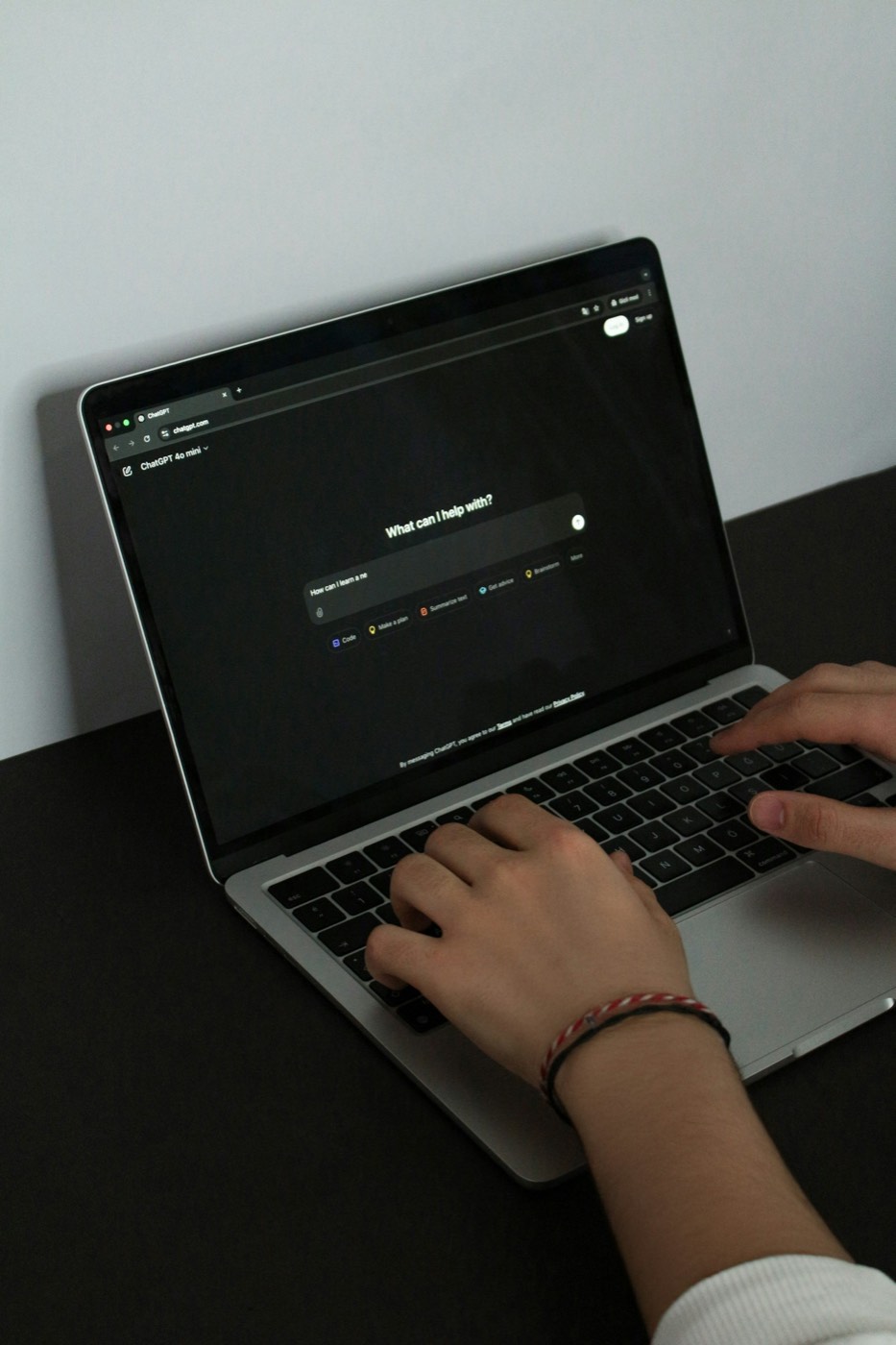
Plenty of small businesses already use ChatGPT to draft emails, summarise complaints or reply to customers. The question is what happens to the customer details that go in with the request, and what the law expects of you when they do.
What counts as customer data when you paste it into ChatGPT?
Anything that identifies a person. The ICO's guidance on what personal data is quotes UK GDPR: personal data means "any information relating to an identified or identifiable natural person". That person can be identified "by reference to an identifier such as a name, an identification number, location data, an online identifier". The ICO adds that "a name and a corporate email address clearly relates to a particular individual and is therefore personal data."
So a customer's name, email address, order history or the text of their complaint all count. A question with no details about any person, such as "rewrite this returns policy more clearly", does not.
What does UK GDPR expect when you use an AI tool with personal data?
The ICO's guidance sets out four expectations that apply here. Checked November 2026; each ICO page notes it is under review following the Data (Use and Access) Act.
- A written contract with any processor. "Every time a controller uses a processor to process personal data, there must be a written contract" (ICO, contracts between controllers and processors).
- A processor you can trust with security. You must keep personal data secure with "appropriate technical and organisational measures", and "you must choose a data processor that provides sufficient guarantees about its security measures" (ICO, a guide to data security).
- A data protection impact assessment. The ICO's AI guidance asks you to judge, case by case, whether your use of AI is "a type of processing likely to result in a high risk" to people, which triggers the legal requirement for a DPIA. It also says "you must carry out your DPIA before the processing of personal data begins" (ICO, accountability and governance of AI).
- Openness with customers. "You need to be transparent about how you process personal data in an AI system" (ICO, transparency in AI).
The same AI guidance explains that a provider which only acts on your instructions is likely to be your processor, while a provider that uses data for its own purposes may be a controller for that part. Which plan you use affects which of those describes your situation. Our compliance page sets out how we handle this in our own work.
Does ChatGPT keep or learn from what you type?
It depends on the plan. This is what OpenAI's own pages say, checked on 14 November 2026.
| Plan | What OpenAI says it does with your inputs | Source | Checked |
|---|---|---|---|
| Individual plans: Free, Go, Plus and Pro | "We may use your content to train our models." You can opt out by turning off Improve the model for everyone under Settings, Data controls. After that, new conversations are not used, though a conversation you rate with a thumbs up or down may still be used. | OpenAI help: how your data is used; ChatGPT pricing | 14 November 2026 |
| Temporary chat, on individual plans | Not used to improve OpenAI's models while it stays temporary. OpenAI "may keep a copy of a temporary chat for up to 30 days for safety purposes." | OpenAI help: temporary chat | 14 November 2026 |
| ChatGPT Business, Enterprise and Edu, and the API | "By default, we don't use inputs or outputs" from these to improve its models. For Business, Enterprise and Edu, that holds unless the organisation has signed a separate agreement allowing it. | OpenAI help: how your data is used | 14 November 2026 |
A personal plan with the training setting switched off suits occasional work with no customer details in it. Once staff handle customer data in ChatGPT as part of the job, a business plan fits the ICO's expectations better, and you should check that its terms give you the written contract the ICO requires.
When is a private or business setup the better choice?
When customer data goes into the tool every day, by several people, as part of a process you rely on. At that point you want one account the business controls, settings an administrator manages, a contract you have read, and a DPIA that describes the real process.
A business plan covers most of that. A setup that keeps customer data in your own systems, sending only what each task needs, goes further, and suits firms with sensitive records or strict customer contracts. It also costs time and money to build, and someone has to maintain it once it is running. We explain how we approach AI integration on our AI page.
When is a non-AI fix the better answer?
If enquiries arrive missing the details you need, a better form with required fields solves it. If staff type the same five replies every week, saved templates do the job with no customer data leaving your systems. If emails need sorting, a simple rule in your inbox may be enough.
Plenty of jobs shouldn't be automated at all. Fix the process first. If a gap remains that only AI can fill, you will know exactly what it needs to do and which data it needs.
What changed in 2026 if AI makes decisions about your customers?
Two parts of the Data (Use and Access) Act 2025 matter here.
New rules on automated decisions came into force on 5 February 2026 (section 80). They cover significant decisions made with "no meaningful human involvement". Where you make one, the safeguards must let the person get information about the decision, make representations, obtain human intervention and contest it. If AI triages enquiries or approves bookings by itself, tell customers, and give them a way to reach a person and challenge the outcome.
Since 19 June 2026, organisations must handle data protection complaints (section 103). You must make complaints easy to send, for example with a form that can be completed electronically, acknowledge each one within 30 days, and tell the complainant the outcome. Our compliance page shows how we approach this ourselves. This section is general information, not legal advice.
Why are so many small firms holding back on AI?
Skills, an unclear business case and data worries come up again and again in the surveys.
- The government's AI adoption survey report 2026, published 29 October 2026 from 3,503 interviews, found limited AI skills affected 67% of businesses using AI and 78% of those planning to. Non-adopters most often cited the lack of a clear business case or proven return on investment (65%).
- Simply Business's 2026 SME Insights Report, from 1,842 small business owners surveyed between 30 July and 7 August 2026, found security and privacy concerns top the list of barriers, cited by 44% of small business owners.
- YouGov's poll of 1,000 SME decision-makers, published 7 August 2025, found 49% of businesses not planning to use AI pointed to data privacy and security.
- The ONS reported that 28% of businesses with 0 to 9 employees used at least one AI technology in June 2026.
- Among businesses using AI, 12% reported an increase in revenue in the government's 2025 AI adoption survey.
How do you decide whether AI is worth it for one job?
Start with one named job, such as replying to enquiries or sorting incoming email, rather than "AI" in general. Then take it through one conversation with a senior builder who has more than 20 years' experience. You leave with a clear answer on whether the job is worth building, and if it is, how customer data would be handled. Sometimes the answer is no, and that is worth knowing before you spend anything.
Frequently asked questions
Should I tell customers that we use AI with their data?
Yes. The ICO's AI guidance says you need to be transparent about how you process personal data in an AI system. Your privacy information should cover, at a high level, your purposes, how long you keep the data and who you share it with, and people should have it before their data is used.
What should I do if staff have already pasted customer details into a personal ChatGPT account?
Turn off Improve the model for everyone under Settings, Data controls, on each personal account in use. OpenAI says that once you opt out it won't use new conversations to improve its models, so the setting covers what is typed from then on. Then agree where customer data may go in future and write it into your staff guidance.
Sources
- ICO, What is personal data?
- ICO, When is a contract needed and why is it important?
- ICO, A guide to data security
- ICO, What are the accountability and governance implications of AI?
- ICO, How do we ensure transparency in AI?
- OpenAI, How your data is used to improve model performance
- OpenAI, Temporary chat in ChatGPT
- OpenAI, ChatGPT pricing (plan names and the privacy row)
- legislation.gov.uk, Data (Use and Access) Act 2025, section 80 (automated decisions, in force 5 February 2026)
- legislation.gov.uk, Data (Use and Access) Act 2025, section 103 (complaints, in force 19 June 2026)
- GOV.UK, AI adoption survey report 2026: executive summary
- GOV.UK, AI adoption survey report 2025
- Simply Business, AI use among UK small businesses more than doubles in a year
- YouGov, We polled UK SME leaders about AI adoption
- ONS, Artificial intelligence in UK businesses: 2023 to 2026